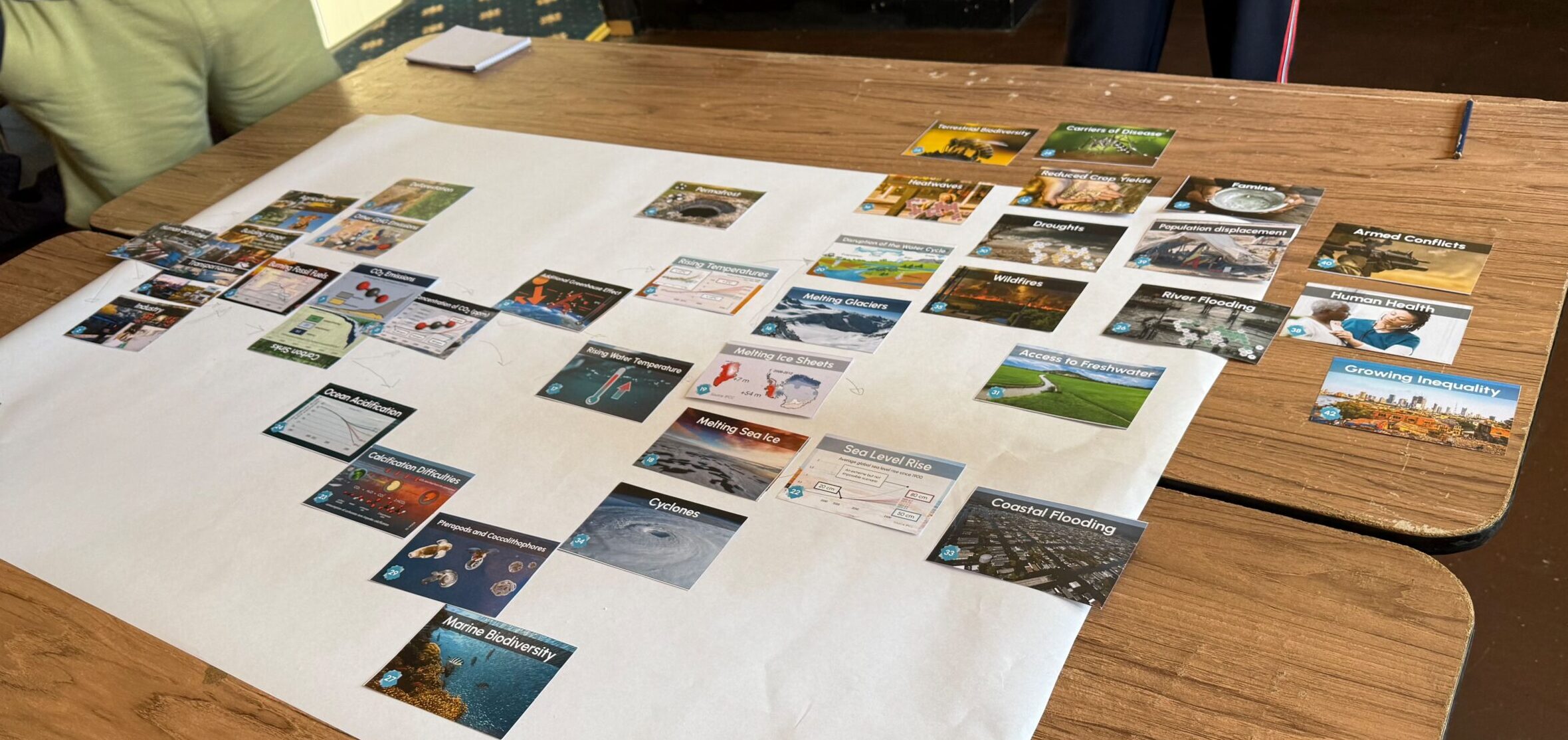
On February 28th, six local residents gathered around a table for something deceptively simple: a facilitated workshop led by the wonderful Lisa using the methodology developed by Climate Fresk.
No speeches, no preaching, no slides full of bullet points. Just cards, conversation, and a structured exploration of the science behind climate change.
What unfolded over the course of three hours was something far more powerful than a typical climate talk. It was clarity.
From Headlines to Systems Thinking
Most of us absorb climate information in fragments — a news article about flooding, a statistic about CO₂, a documentary about melting ice. The result can feel overwhelming and disconnected.
The Climate Fresk process does something quite different. Participants work collaboratively to arrange a set of scientifically grounded cards into cause-and- effect chains. Greenhouse gas emissions link to atmospheric concentration. Temperature rise connects to ocean warming. Deforestation links to biodiversity loss. Agriculture intersects with land-use change.
Gradually, the pieces form a system. You can see the interdependencies. You can trace feedback loops. You begin to understand not just what is happening — but why.
The Power of Small Groups
With only six of us in attendance, the discussion was authentic, honest, and thoughtful. Questions were explored properly. Assumptions were challenged respectfully.
Lisa guided without dominating. She allowed the science to speak for itself, stepping in only to clarify or deepen understanding when needed.
What stood out most was the tone of the session: calm, grounded, and constructive. There was no sense of doom-mongering, no political grandstanding – just shared learning.
In a world where climate discourse is often polarised, that matters.
From Understanding to Agency
The workshop closes by turning attention to action. Once you see the system, you naturally begin to ask: What levers can I realistically pull?
The challenges vary. Some relate to energy use. Others to food choices, travel behaviour, purchasing decisions, or civic engagement. Importantly, the focus is not on perfection. It is on agency—what’s easy (or hard) to do and what’s the potential impact.For a local community like ours, this is precisely where momentum begins. We take away real-life things we can do for ourselves—no excuses.
Why This Matters for EcoTitchfield
At EcoTitchfield, we are not interested in abstract sustainability. We are interested in practical literacy—helping people understand the material and energy consequences of everyday decisions.
The Climate Fresk methodology aligns perfectly with that ambition.
• It builds systems awareness.
• It encourages evidence-based thinking.
• It creates informed residents rather than passive consumers of headlines.
Six people around a table may not sound like a revolution. But cultural shifts rarely start with crowds. They begin with informed personal conversations, repeated steadily over time.
If each of us leaves with a clearer mental model of how emissions, ecosystems, economics, and behaviour interact, that understanding ripples outward—into households, workplaces, and community discussions. And that is how changes start to happen.
Looking Ahead
We are enormously grateful to Lisa for facilitating with such care and professionalism. The atmosphere she created allowed learning without judgement and reflection without anxiety.
If there is sufficient interest, we would love to host further sessions locally. Climate literacy is not a luxury; it is foundational knowledge for the century we are living in.
If you would like to participate in a future workshop, please let us know. Six seats at a table can change how a community thinks.
And how a community thinks determines how it acts.
small steps, big changes